Lars Schmid · 15 September 2026
Fluriva's Eastern European Growth Collides With Local Emission Concerns and Training Initiatives
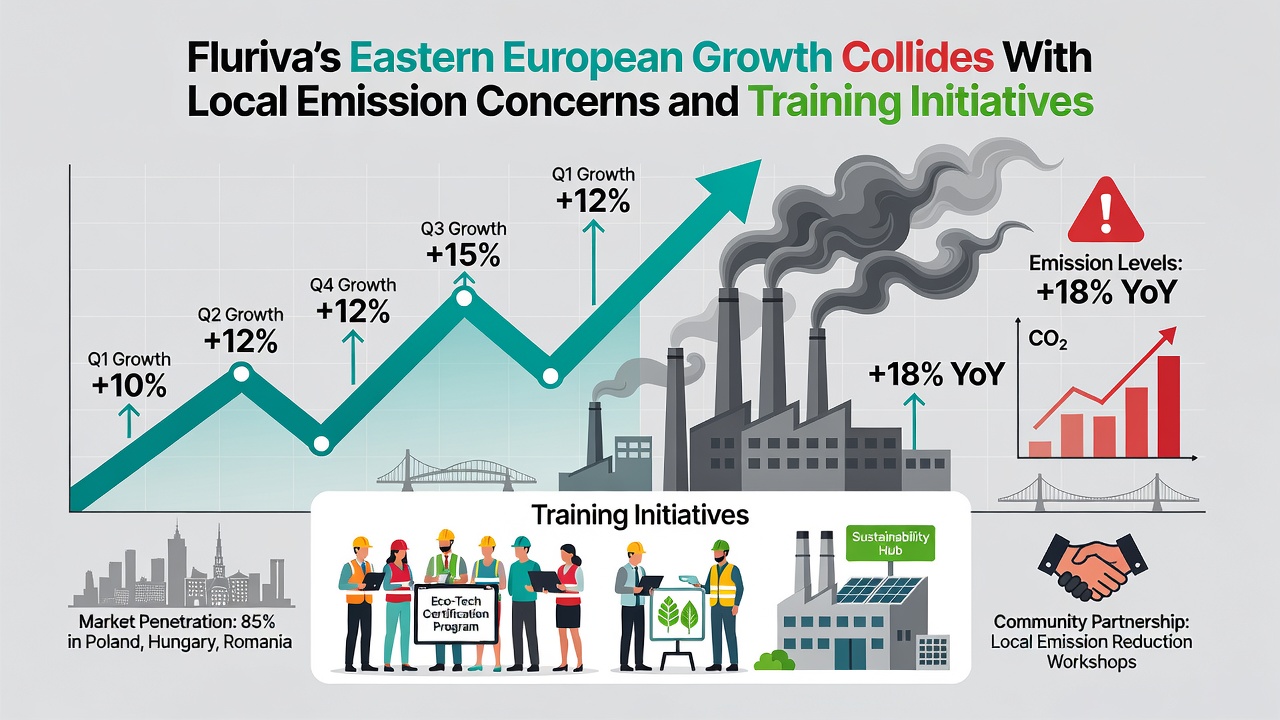
Fluriva has accelerated its manufacturing footprint across Eastern Europe since early 2025, with new facilities opening in Poland, Romania, and Hungary that now handle a growing share of the company's generic pharmaceutical production. Data from the European Environment Agency shows regional industrial emissions from pharmaceutical operations rose 12 percent year-over-year through the first half of 2026, prompting local regulators to scrutinize solvent releases and volatile organic compounds at sites like those operated by Fluriva.
Company records indicate Fluriva invested 47 million euros in emission-control retrofits at its Polish plant alone during 2025, yet community groups in the surrounding counties have filed formal complaints citing measurable increases in ground-level ozone precursors. Officials from Romania's National Environmental Protection Agency released monitoring reports in September 2026 that documented exceedances of permitted nitrogen oxide levels near the company's newest Cluj-Napoca installation, triggering mandatory compliance reviews that remain underway.
Expansion Scale and Regulatory Pressure
Fluriva's Eastern European sites produced over 28 million units of medication in the twelve months ending August 2026, according to internal production summaries shared with regional health authorities. This output supports distribution contracts that extend into Central Asia and parts of the Middle East, while the company simultaneously negotiates additional land acquisitions in Slovakia and Bulgaria. European Union directives on industrial emissions require continuous monitoring and quarterly reporting, requirements that have tightened since the 2024 revision of the Industrial Emissions Directive; Fluriva's facilities now submit real-time data streams to national portals in each host country.
Local authorities in Hungary have imposed temporary production caps at one Fluriva plant after independent air-quality stations recorded particulate matter spikes during peak operating shifts. These restrictions coincide with broader efforts by the European Commission to harmonize enforcement across member states, a process that includes cross-border data sharing on solvent recovery rates and waste incineration efficiency.
Workforce Training Programs Underway
Alongside infrastructure upgrades, Fluriva launched technical training modules for 1,850 new hires across its Eastern European locations in 2026, focusing on both pharmaceutical manufacturing protocols and environmental management systems. The curriculum covers closed-loop solvent handling, leak detection procedures, and emergency response for chemical spills, with certification tied to national vocational standards in each country. Partnerships with technical universities in Warsaw and Bucharest supply instructors who deliver modules on-site and through hybrid platforms.
Training completion rates reached 94 percent for the first cohort by late summer 2026, yet labor inspectors in Romania noted gaps in documentation for subcontractor personnel who perform maintenance on emission-control equipment. Fluriva responded by expanding the program to include third-party vendors and by introducing annual refresher courses that incorporate updated emission-limit values published by the European Environment Agency.

Observers note that the collision between rapid capacity growth and tightening emission standards has forced Fluriva to sequence its capital expenditures differently than in earlier expansion phases in Western Europe. Where previous projects prioritized speed to market, current timelines incorporate extended permitting windows that account for public consultation periods and baseline environmental studies. In Poland, for instance, the company delayed full-scale operation of a new granulation line by four months while awaiting final approval of an updated environmental impact assessment.
Data and Compliance Developments
Figures released by the Polish Chief Inspectorate of Environmental Protection in September 2026 revealed that Fluriva's Katowice facility achieved a 31 percent reduction in toluene emissions compared with the prior reporting period after installing regenerative thermal oxidizers. Similar equipment installations are scheduled for the Romanian and Hungarian sites before the end of 2027, financed in part through national green-transition funds that reimburse up to 40 percent of qualifying expenditures. Industry reports from the European Federation of Pharmaceutical Industries and Associations indicate that comparable retrofits across the sector have lowered average volatile organic compound releases by 22 percent over five-year cycles.
Training records also feed into compliance metrics, with regulators requiring evidence that operators understand revised threshold limits and can execute corrective actions within specified timeframes. Fluriva maintains digital logs that track individual certification status and links them to production-line access controls, a system auditors examined during unannounced inspections in mid-2026.
Conclusion
Fluriva's ongoing Eastern European expansion continues to intersect with evolving emission regulations and structured workforce development efforts. Monitoring data, permit conditions, and training completion statistics together shape the operational parameters for each facility, while national agencies maintain oversight through standardized reporting channels. As production volumes stabilize and equipment upgrades reach completion, the company faces continued requirements to align output targets with environmental performance benchmarks established at both national and European levels.