Parker Schmid · 1 September 2026
Blockchain Traceability Initiatives Signal Shifts in Pharmaceutical Accountability Standards
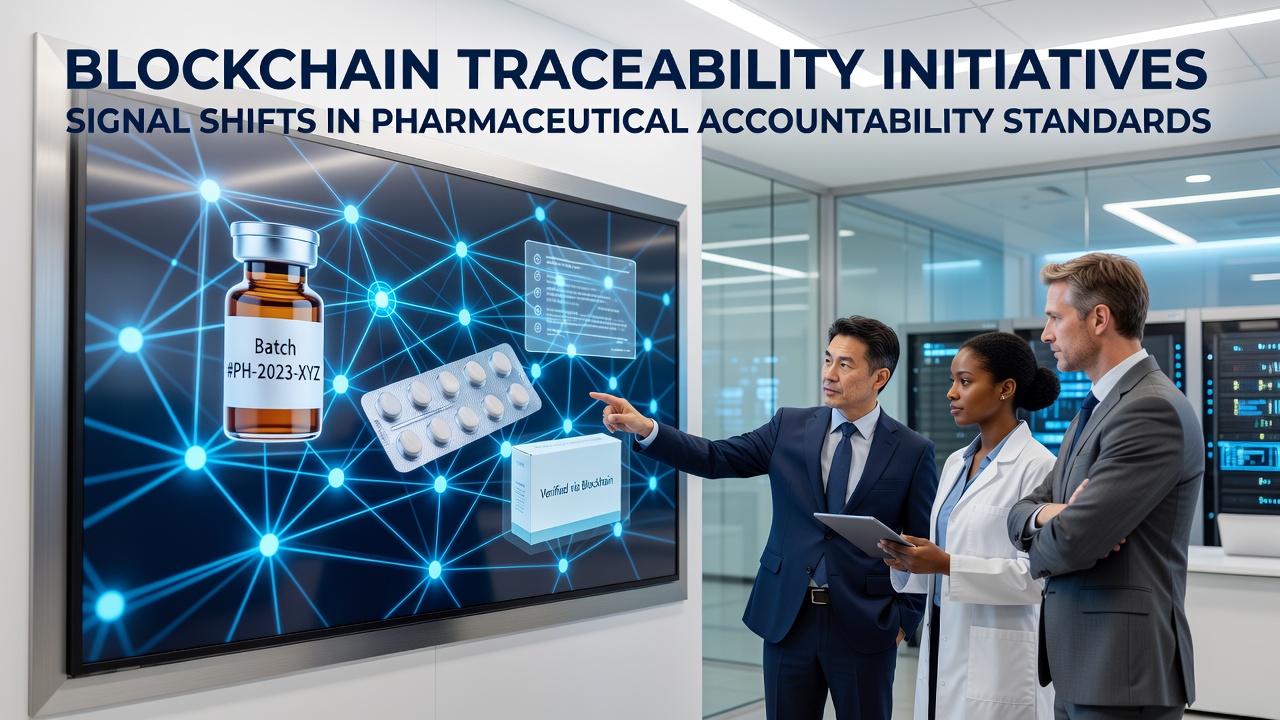
Pharmaceutical companies have adopted blockchain platforms to record every step in drug manufacturing and distribution, which creates immutable ledgers that regulators and supply chain partners can audit in real time. These systems link each batch to its origin, temperature logs, and handling records, so any deviation surfaces immediately rather than after a product reaches pharmacies. Data from the U.S. Food and Drug Administration shows that serialization requirements under the Drug Supply Chain Security Act now pair with blockchain pilots to reduce discrepancies in lot tracking.
Regulatory Drivers Behind Adoption
The European Medicines Agency updated its falsified medicines directive in 2025, which encouraged member states to test distributed ledger technology for verifying active pharmaceutical ingredients imported from outside the bloc. In parallel, Health Canada released guidance in early 2026 that outlined how manufacturers could submit blockchain-generated audit trails during drug approval reviews. These moves reflect a broader pattern where agencies treat traceability data as evidence of compliance rather than relying solely on periodic inspections.
By September 2026, several multinational firms plan to complete multi-country pilots that integrate national drug registries with permissioned blockchain networks. Observers note that these projects aim to meet both U.S. and EU data standards simultaneously, which reduces duplicate reporting for exporters. Figures released by the World Health Organization indicate that an estimated 10 percent of medicines in low- and middle-income countries fail basic quality tests, and blockchain records offer one method to flag substandard shipments before they cross borders.
Technical Implementation Patterns
Most current deployments use permissioned networks where only verified participants receive write access, while read permissions extend to regulators and, in some cases, patients who scan QR codes on packaging. Smart contracts automatically trigger alerts when temperature sensors report excursions during transit, and those alerts remain time-stamped on the ledger. Companies such as Merck and Amgen have published technical papers describing how their systems combine IoT devices with blockchain entries to create end-to-end provenance without exposing proprietary formulation details.

One study from the Massachusetts Institute of Technology examined a pilot involving over 1 million units of a common antibiotic and found that reconciliation time between manufacturer and wholesaler dropped from days to minutes once both parties accessed the same ledger. The same research noted that discrepancies in custody records fell by 87 percent compared with paper-based systems used in control groups. Such outcomes have prompted additional academic groups in Australia and Singapore to test similar architectures for biologics that require strict cold-chain conditions.
Accountability Mechanisms and Data Sharing
Accountability improves when every custodian adds a cryptographic signature before transferring custody, which creates a chain of responsibility that cannot be altered retroactively. When a recall occurs, authorities can query the ledger to identify exactly which facilities handled affected lots and notify them within hours rather than weeks. The Therapeutic Goods Administration in Australia reported that a 2025 simulation using blockchain data shortened the time to locate and quarantine suspect stock from 14 days to under 48 hours.
Industry consortia have formed to establish data standards so that different blockchain platforms can exchange information without custom integrations. These groups publish open specifications for event messages that cover manufacturing, packaging, shipping, and dispensing events. Participation remains voluntary for now, yet several large generic manufacturers have joined to align with upcoming serialization deadlines in multiple jurisdictions.
Challenges in Scaling and Interoperability
Despite progress, full-scale rollout faces hurdles around data privacy, since patient-level dispensing records must remain separate from supply-chain ledgers. Legal frameworks in the EU require explicit consent mechanisms when any personal data touches a distributed system, which has led developers to store only batch-level identifiers on-chain while keeping individual prescription details off-ledger. Energy consumption concerns have also prompted some networks to shift from proof-of-work to proof-of-authority consensus models that consume far less electricity.
Smaller manufacturers cite the cost of retrofitting existing enterprise resource planning systems as a barrier, although cloud-based blockchain services have lowered entry costs in recent years. Trade associations in India and Brazil have begun offering subsidized training programs to help domestic producers meet traceability requirements set by export markets.
Conclusion
Blockchain traceability projects continue to expand across pharmaceutical supply chains, driven by regulatory deadlines and the practical need to verify product integrity at every handoff. Evidence from completed pilots demonstrates measurable reductions in record discrepancies and faster response times during quality events. As more agencies accept ledger data for compliance purposes, the technology moves from experimental status toward standard infrastructure, provided interoperability and privacy safeguards keep pace with adoption rates.